

Storage Humidity Protection Advisor
Protect your belongings from mold and damage. Answer a few questions to get a personalized recommendation for your storage unit.
Your Recommended Strategy
You’ve just moved your belongings into a new storage unit. It’s clean, it’s dry, and you feel good about the decision. Three months later, you open the door to find a musty smell hitting you in the face, or worse, white fuzz growing on your leather jacket. This isn’t bad luck; it’s physics. Unheated storage spaces are notorious traps for humidity. The concrete floor wicks moisture from the ground, temperature swings cause condensation, and without airflow, that dampness turns into mold.
So, what actually works? You’ll see everything from cheap cardboard boxes of crystals to high-end electric machines. But not every solution fits every situation. If you’re storing sensitive electronics, you need different protection than if you’re keeping old books or winter clothes. Choosing the right tool depends entirely on your budget, how often you visit, and what’s inside that metal box.
Understanding Why Your Unit Gets Damp
Before you buy anything, you need to know what you’re fighting. Humidity in storage units usually comes from three sources: the ground beneath the concrete slab, outside air entering through vents, and the items themselves releasing moisture as they adjust to the new environment. In places like Melbourne, where we get cold nights and warm days, this cycle is relentless. Warm air holds more water vapor than cold air. When that warm, moist air hits the cooler walls or floors of your unit, it condenses into liquid water. That’s why things feel wet even when it hasn’t rained inside.
The danger zone is relative humidity (RH) above 60%. Below 50% is ideal for most household items. Above 70%, mold spores start germinating rapidly. Your goal isn’t to make the unit desert-dry-that can crack wood furniture-but to keep it stable between 40% and 50%. Most people don’t have hygrometers in their pockets, so you’re often guessing. That’s why picking the right absorber matters so much.
The Heavyweight Champion: Desiccant Dehumidifiers
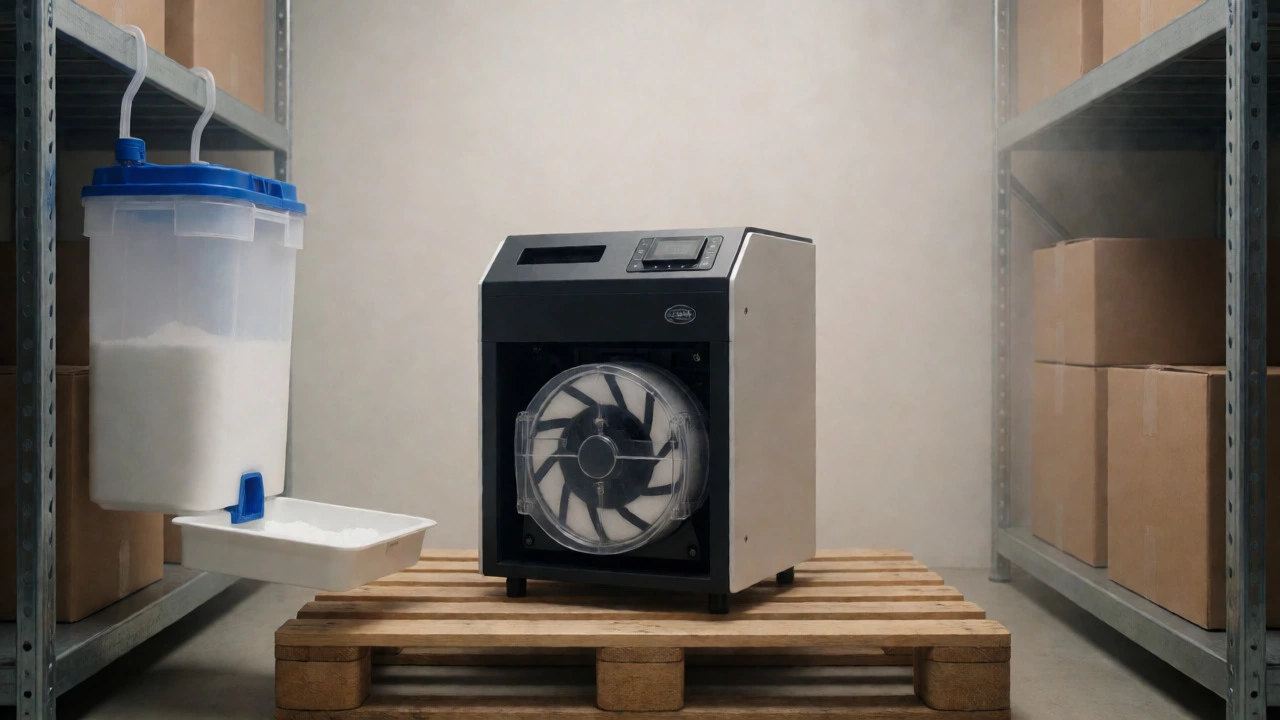
If you want serious protection and don’t mind spending money upfront, look at desiccant dehumidifiers. Unlike standard compressor models that struggle in cool temperatures, desiccants use a rotating wheel coated with silica gel to pull moisture out of the air. They work efficiently even when the unit is chilly, which is exactly when condensation happens most.
Brands like Meaco or EcoAir offer compact models designed specifically for small spaces. These aren’t huge industrial machines; some fit under a shelf. They require electricity, so you need an outlet in your unit. Check with your facility manager first-some older buildings don’t provide power, or charge extra for it. If you have power, this is the gold standard. It maintains consistent humidity levels automatically. You set the target RH, and it runs until it hits that mark.
However, they cost anywhere from $300 to $800 AUD. For a one-time move of non-sensitive items, that might be overkill. But if you’re storing antiques, musical instruments, or important documents long-term, the investment pays off by preventing restoration costs later.
The Popular Choice: Calcium Chloride Crystals
You’ve probably seen those plastic tubs with hanging bags filled with white pellets. These are calcium chloride absorbers, sold under brands like DampRid or generic hardware store labels. They are passive, meaning they do nothing until you hang them up. They work by attracting water vapor, which dissolves the calcium chloride into a brine that drips into a collection tray at the bottom.
These are incredibly popular because they are cheap ($15-$30 AUD per unit) and easy to find. One tub can absorb up to 10 liters of water depending on humidity levels. But here’s the catch: they saturate quickly. In a humid summer week, a single tub might fill up completely. If you ignore it, the bag stops working, and the collected water can leak if the tray tips over.
They are best for short-term storage or moderate climates. If you live in a very humid area or store items for years, you’ll end up buying replacement refills constantly. At $10 a pop, that adds up. Plus, they don’t give you feedback. You won’t know they’re full until you check visually. Many people forget to check, leaving their items unprotected for weeks.
The Budget Option: Silica Gel Packs
Silica gel is the little packet you find in shoe boxes and handbag packaging. It’s excellent at absorbing moisture in small, enclosed spaces. Think closets, safes, or individual boxes within your storage unit. It doesn’t work well for the whole room because it has limited capacity compared to larger systems.
To use it effectively, you need volume. Buying bulk silica gel beads and putting them in breathable mesh bags is smarter than relying on tiny packets. Place these bags directly next to sensitive items. For example, put a large mesh bag of silica gel inside your suitcase with clothes, or wrap it around a guitar case. Because silica gel changes color when saturated (if you buy indicator type), you know when to replace or recharge it. You can recharge many types by baking them in the oven at low heat, making them reusable.
Silica gel is perfect for protecting specific valuables rather than controlling the entire unit’s climate. Use it as a second line of defense alongside another method.
Comparing Your Options
How do you choose? Let’s break it down by scenario. Here is a quick comparison of the main methods:
| Method | Cost (AUD) | Maintenance | Best For | Effectiveness |
|---|---|---|---|---|
| Desiccant Dehumidifier | $300 - $800 | Low (Empty tank occasionally) | Long-term, sensitive items, electronics | High |
| Calcium Chloride Tub | $15 - $30 | Medium (Check weekly/monthly) | Short-term, general household goods | Medium |
| Silica Gel Packs | $5 - $20 (bulk) | Low (Replace/recharge rarely) | Small containers, clothing, books | Low (Localized only) |
| Charcoal Bags | $10 - $25 | Low (Sun dry monthly) | Odor control, mild humidity | Low |

Pro Tips for Maximum Protection
No matter which absorber you choose, placement matters. Don’t just throw a tub in the corner. Air needs to circulate around it. Elevate your items off the concrete floor using pallets or plastic shelving. Concrete is cold and wicks moisture upward. If your boxes sit directly on the slab, they will get damp regardless of what hangs from the ceiling.
Also, consider ventilation. If your unit has a vent, ensure it’s not blocked. Some facilities allow you to prop the door open slightly when you visit to let fresh air in, but be careful-if the outside air is more humid than the inside, you’re making it worse. Only ventilate when the weather is dry and breezy.
Another trick: use vapor barriers. Wrapping furniture in plastic sheeting helps, but don’t seal it too tight if there’s existing moisture trapped inside. Trapped moisture can rot wood from the inside out. Instead, use breathable covers like cotton drop cloths. They protect against dust while allowing some air exchange.
When to Upgrade Your Strategy
If you’ve tried basic absorbers and still find mold, you need to step up. Mold indicates sustained high humidity. At this point, passive methods aren’t cutting it. You likely need active removal. Renting a portable dehumidifier for the first month can help reset the environment. Once the unit is dry, maintain it with calcium chloride or silica gel.
Remember, prevention is cheaper than cure. Cleaning mold off a leather couch or restoring warped wood tables costs hundreds of dollars. Spending $50 on good absorbers now saves you that headache later. Inspect your unit every time you visit. Look for dark spots on corners, rust on metal frames, or a sour smell. These are early warnings.
Can I use rice as a moisture absorber?
While rice does absorb some moisture, it is not efficient enough for a whole storage unit. It also risks attracting pests like mice or insects, which love stored grains. Stick to purpose-built chemical absorbers or silica gel.
How many calcium chloride tubs do I need?
A general rule of thumb is one 4kg tub for every 10 square meters of space in moderately humid conditions. For larger units or very humid climates, double this amount and place them at opposite ends of the unit to encourage circulation.
Do charcoal bags remove moisture?
Activated charcoal primarily absorbs odors and volatile organic compounds (VOCs). It has minimal moisture-absorbing capacity compared to calcium chloride or silica gel. Use it to keep the unit smelling fresh, but not as your primary humidity control.
Is it safe to store electronics with moisture absorbers?
Yes, but avoid direct contact with leaking calcium chloride trays. Place electronics on shelves away from the floor and position absorbers nearby, not touching the devices. Silica gel packs placed inside the device's original box are safest for cameras and laptops.
How often should I check my moisture absorber?
Check passive absorbers like calcium chloride tubs every 2-4 weeks initially to gauge your unit's humidity rate. Once you know how fast they fill, adjust your schedule. Electric dehumidifiers only need tank emptying when full, which varies by model and humidity level.