
TV Stand Compatibility Calculator
Check Your TV Stand Safety
Enter your TV's weight and base dimensions to determine if your stand is safe.
Results
Enter your TV details to see if your stand is safe.
Every year, thousands of people buy a new flat screen TV and immediately wonder: Can you put a flat screen TV on a stand? The answer isn’t as simple as yes or no. It depends on your TV’s weight, the stand’s design, and whether you’re trying to make it work safely - not just visually.
Not All TV Stands Are Made the Same
TV stands aren’t one-size-fits-all. Some are built for old CRT TVs from the 90s - heavy, boxy, and small. Others are made for sleek 75-inch OLEDs that weigh less than 25kg but have a wide, thin base. If you slap a modern TV on an old stand meant for a 32-inch model, you’re risking a tip-over. That’s not just a mess - it’s dangerous. Look at the manufacturer’s specs. Most flat screen TVs list a VESA mount pattern (like 200x200mm or 400x400mm) and a recommended stand weight limit. If your TV weighs 18kg and the stand says it supports up to 15kg, don’t ignore that. Manufacturers test these limits under controlled conditions. Real-world conditions - like kids running past, pets jumping, or even a strong draft - can push things over.Check the Base Width and Stability
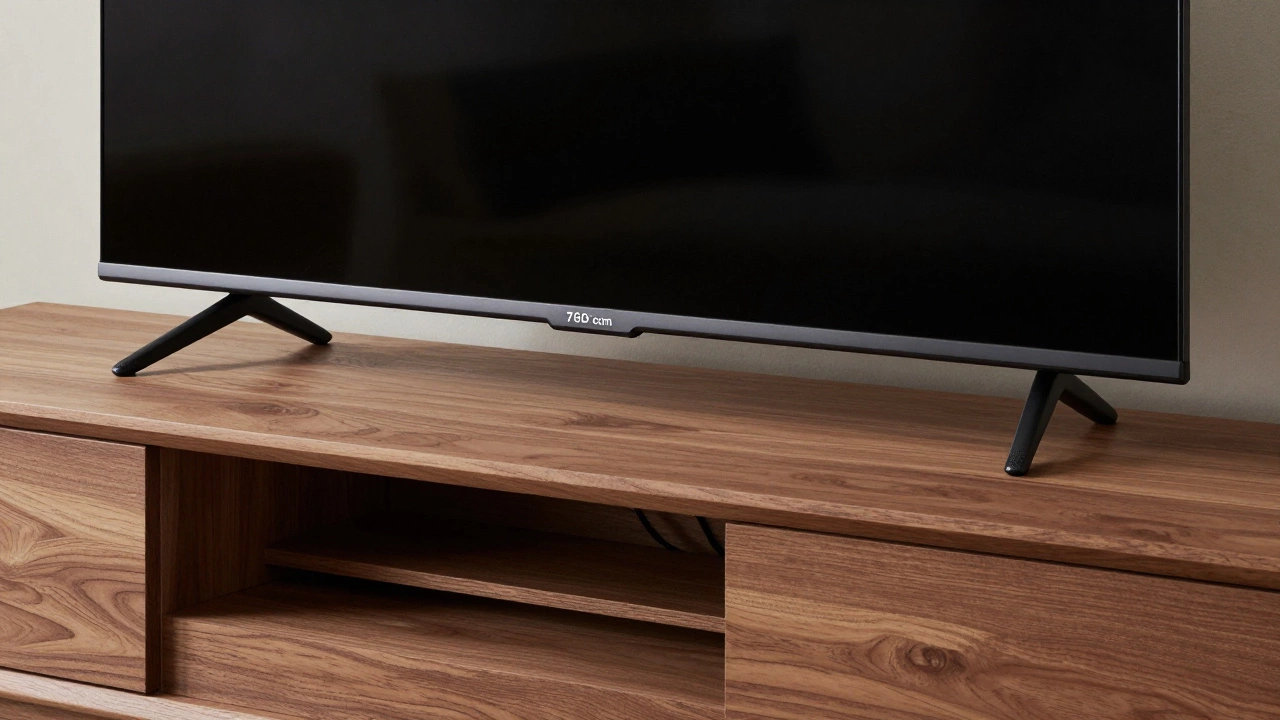
A flat screen TV’s base isn’t just a decorative foot. It’s the only thing keeping it upright. If the stand’s top surface is narrower than the TV’s base, it won’t sit flush. That creates an unstable, teetering effect. Even if the stand claims to hold the weight, if the TV overhangs on both sides, it becomes a lever. A small bump - like someone brushing past it - can turn into a falling TV. Measure both. Use a tape measure. Don’t guess. If your TV’s base is 60cm wide, the stand’s top surface needs to be at least 65cm. That 5cm overhang on each side gives you breathing room. Better yet, go for a stand that’s wider than the TV. A stand that’s 80cm wide with a 60cm TV? That’s stable.Weight Matters More Than You Think
People assume bigger TVs are heavier. That’s true - but not always. A 55-inch LED TV can weigh 16kg. A 65-inch OLED? Sometimes just 20kg. Why? Because OLED panels are thinner and use lighter materials. Meanwhile, a 50-inch plasma from 2010 might weigh 40kg. So don’t assume size = weight. Check your TV’s manual or the label on the back. It’ll list the exact weight. Compare that to the stand’s max load. If your TV is 19kg and the stand says 25kg, you’re safe - as long as the base fits. But if the stand says 18kg? Don’t risk it. That 1kg buffer isn’t there for fun. It’s for safety margins.
Stands With Built-In Cable Management Are Better
A TV stand with hidden cable channels isn’t just neat - it’s safer. Loose cords dangled behind the TV? They’re trip hazards. But more importantly, if someone pulls on a power cable or HDMI wire, that force can tug the TV off-center. Even a slight shift can unbalance it. Stands with built-in routing - like channels under the top surface or behind side panels - keep cables taut and out of the way. That reduces the chance of accidental pulls. Look for stands with rubberized grips on the top surface too. That stops the TV from sliding forward when you adjust the soundbar or game console.What About Wall Mounts? Are They Better?
Some people say wall mounts are the only safe option. That’s not entirely true. A properly fitted stand is just as safe - if it’s the right one. But wall mounts do have advantages: no risk of tipping, cleaner look, better viewing angles, and no furniture blocking your view. But here’s the catch: wall mounts require drilling into studs. If you’re renting, that’s a no-go. If your wall is plasterboard with no backing, you need special anchors. And if you’re not confident with power tools? You’re better off with a solid stand. A good stand doesn’t need screws or tools. Just place the TV on it. That’s why so many people still choose stands - especially in homes with kids, pets, or frequent movement.Real-World Example: What Went Wrong
In Melbourne, a family bought a 65-inch LG OLED on sale. They put it on an old wooden TV stand they’d had since 2015. The stand was rated for 20kg. The TV weighed 21.3kg. The base was 72cm wide. The stand’s surface? Only 68cm. They didn’t check. Three weeks later, the dog jumped up on the couch and knocked the soundbar. The cable tugged. The TV tilted forward - just 5 degrees. Then it crashed to the floor. Screen shattered. Soundbar broken. Couch cushion stained with glass dust. They spent $1,200 on a new TV and $300 on a new stand with a 90cm top, rubber grips, and a 30kg weight rating. The lesson? Don’t wait for disaster to happen.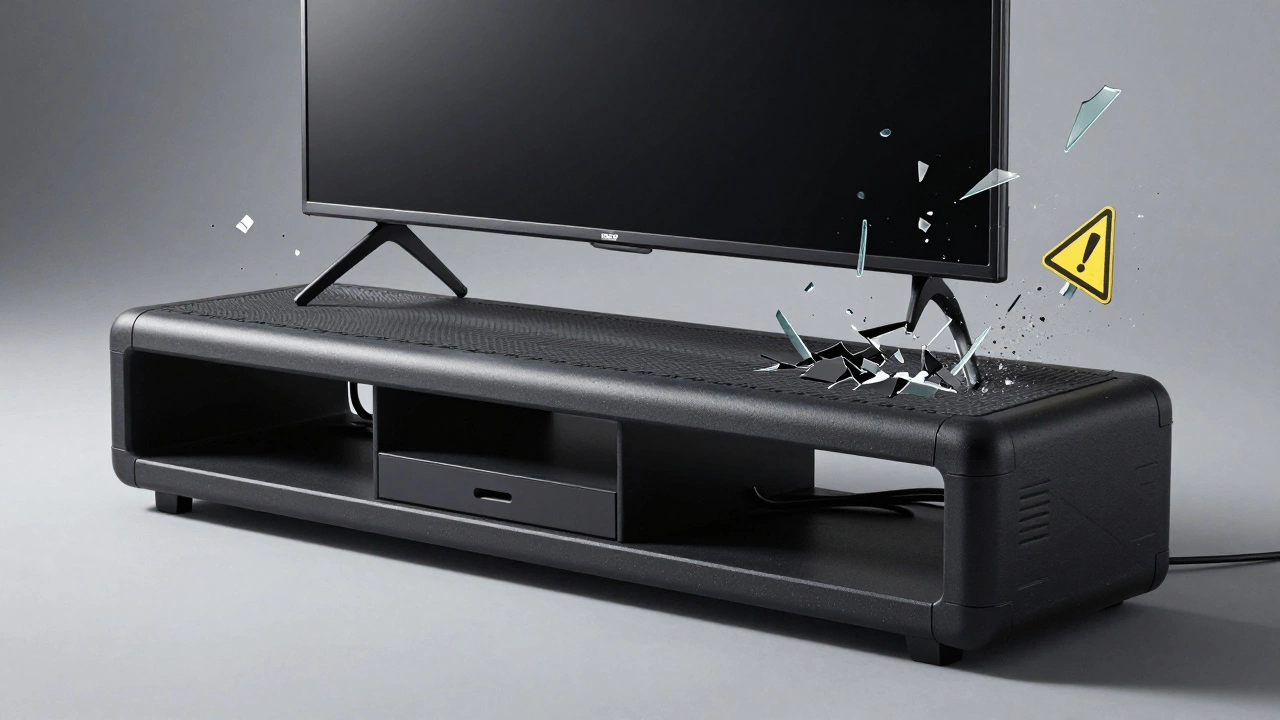
What to Look for in a TV Stand
Here’s a simple checklist before you buy or reuse a stand:- Stand weight capacity ≥ TV weight (add 2kg buffer)
- Top surface width ≥ TV base width + 5cm on each side
- Non-slip surface or rubber pads
- Cable management channels
- Sturdy construction - no wobble when you push it gently
- No sharp edges or protruding screws near the TV
Can You Use a Coffee Table as a TV Stand?
It’s tempting. Coffee tables are low, stylish, and already in the room. But most aren’t designed for TVs. Their tops are often too small. Their legs are too thin. Their weight limits? Usually under 10kg. A 50-inch TV on a 45cm-wide coffee table? That’s a recipe for disaster. Even if the table looks sturdy, the TV’s center of gravity is way too high for such a narrow base. You’re creating a top-heavy structure. That’s unstable by physics, not opinion. If you want a low profile, buy a TV stand designed for it. There are low-profile stands made specifically for flat screens that sit just 15cm off the ground. They’re safer and look better than a coffee table pretending to be a TV stand.Final Rule: When in Doubt, Go Bigger
If you’re unsure whether a stand works, choose the next size up. A stand rated for 30kg with a 90cm top? Even if your TV is only 15kg and 60cm wide, that’s overkill - and that’s exactly what you want. Safety isn’t about saving money. It’s about preventing a moment of regret that costs hundreds - or worse, causes injury. A TV stand isn’t furniture. It’s a support system. Treat it like one.Don’t guess. Measure. Check. Then buy.