
Couch Durability Calculator
Couch Specifications
Usage Factors
You’ve seen the ads: $5,000 leather sectionals with hand-stitched seams, solid hardwood frames, and cushions that feel like clouds. Then there’s the $800 couch from the big-box store that’s already sagging after a year. It’s natural to wonder - does paying more mean your couch actually lasts longer? The answer isn’t simple, but it’s not magic either.
What Makes a Couch Last?
A couch doesn’t last because it’s expensive. It lasts because of what’s inside. The price tag is just a reflection of the materials and construction. A $3,000 couch might seem like a luxury, but if it uses particleboard frames and low-density foam, it’ll wear out faster than a $1,200 couch built right.
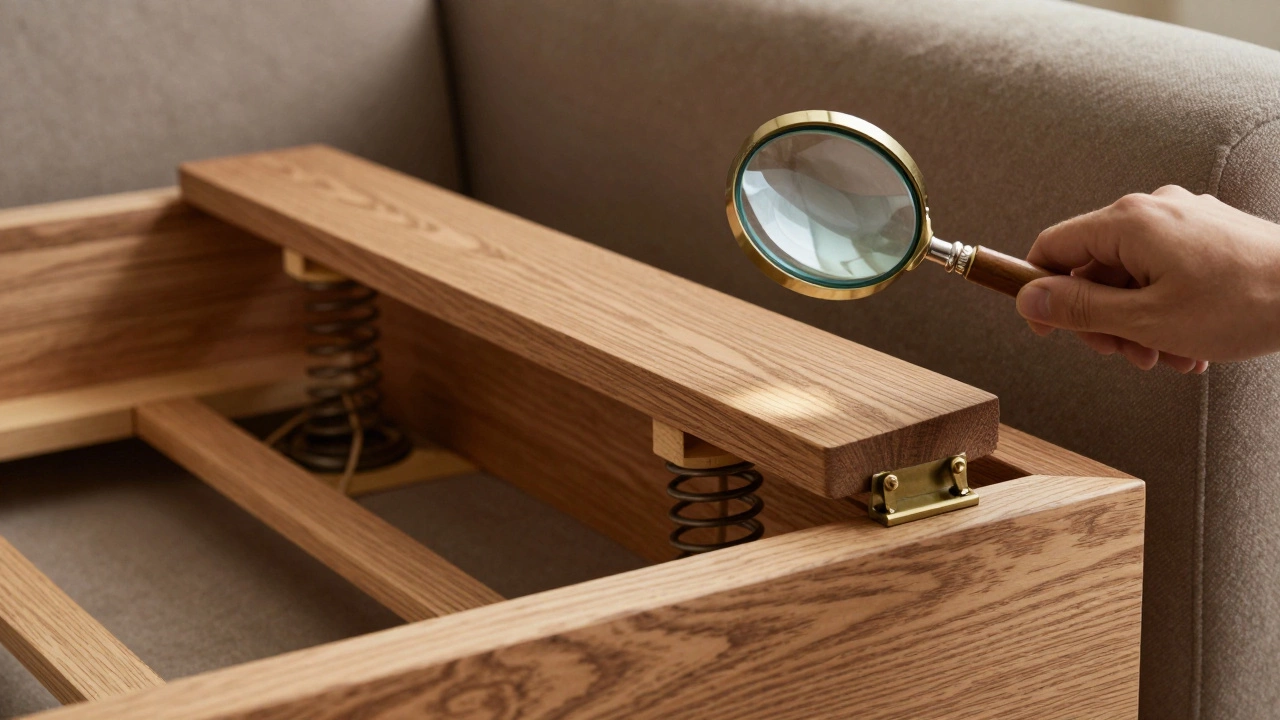
Let’s break it down. The frame is the skeleton. Solid hardwood - like kiln-dried oak, maple, or beech - is the gold standard. It resists warping and can handle years of weight and movement. You’ll rarely see this in budget couches. Instead, they use engineered wood, plywood, or even plastic-composite frames. These are cheaper to make, but they crack, split, or loosen over time, especially in humid climates like Melbourne’s.
Then there’s the suspension system. The webbing or springs underneath the seat determine how well the couch holds its shape. Eight-way hand-tied springs are the most durable, found in high-end pieces. Sinuous springs (S-shaped metal coils) are common in mid-range couches and still hold up well for 10-15 years. But if you see plastic or elastic webbing stretched across the frame? That’s a red flag. It stretches out fast, leading to that dreaded sag.
How Cushions Decide Your Couch’s Lifespan
Cushions are where most people feel the difference - and where most couches fail. High-density foam is the key. Look for foam with a density of at least 1.8 pounds per cubic foot. Anything below 1.5 is cheap and compresses fast. A $600 couch might use 1.2 density foam - it feels soft at first, but after six months, it’s flat as a pancake.
Down and feather blends are plush and luxurious, but they need fluffing and re-plumping. They’re not for people who want a couch that stays perfect without effort. If you’re after comfort without constant maintenance, go for high-resiliency foam wrapped in a thin layer of down. That gives you the softness without the collapse.
Memory foam? It’s great for pressure relief, but it’s not ideal for daily family use. It retains heat and can break down faster under constant pressure. Stick with foam blends if you have kids, pets, or just sit on the couch for hours after work.
Upholstery: Fabric vs. Leather
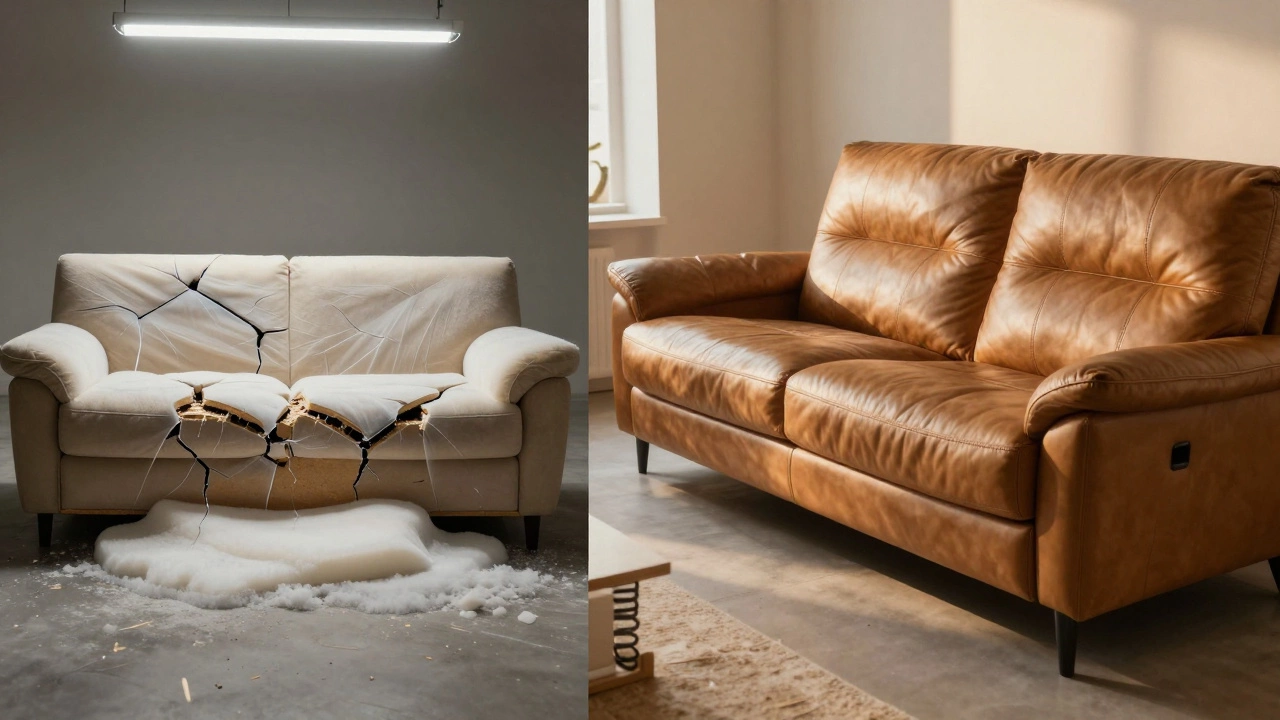
Leather gets all the attention. And yes, full-grain top leather is tough. It lasts 15-25 years with basic care. But not all leather is equal. Bonded leather? That’s just scraps glued together with a thin plastic coating. It peels, cracks, and looks worse than fabric after five years. Always ask: is it full-grain, top-grain, or bonded? If the salesperson can’t tell you, walk away.
Fabric couches can last just as long - if you pick the right one. Performance fabrics like Crypton, Sunbrella, or Revolution are designed for heavy use. They’re stain-resistant, fade-resistant, and hold up to pet claws and spilled coffee. You can clean them with soap and water. These fabrics cost more than standard cotton or polyester, but they’re worth every dollar if you’re not planning to replace your couch in five years.
Standard cotton blends? They fade, pill, and stain easily. A $1,500 couch with a cotton cover might look nice today, but it’ll look worn out by year three.

Brand vs. Builder: Who’s Really Making Your Couch?
Big-name brands like Pottery Barn or West Elm charge more for the name, the design, and the customer service. But here’s the truth: many of them outsource production to the same factories as lesser-known brands. The difference? The markup.
Smaller, local makers often use better materials because they’re not paying for flashy ads or retail markups. A custom sofa from a Melbourne-based cabinetmaker might cost $2,800, but it’s built with solid oak, hand-tied springs, and 2.0 density foam - all with a 10-year warranty. A similar-looking couch from a national chain might cost $3,200 but use plywood and 1.5 foam.
Don’t assume the expensive brand is the better build. Look at the specs, not the logo. Ask for the frame material, foam density, and suspension type. If they can’t give you the numbers, they’re hiding something.
Warranties Tell the Real Story
A good warranty isn’t a sales pitch - it’s a confidence badge. A 10-year warranty on the frame and springs? That’s a sign the maker believes in their product. A one-year warranty? That’s a red flag. Most couches fail between years two and five. If the company doesn’t cover that window, they know it’s a weak spot.
Read the fine print. Some warranties cover only manufacturing defects, not sagging or fabric wear. That’s meaningless. Look for warranties that cover frame, springs, and cushion support. Some high-end makers even cover fabric fading or staining. That’s rare, but when you see it, it’s worth paying for.
What You’re Really Paying For
When you spend $4,000 on a couch, you’re not just buying durability. You’re buying:
- Time: No need to replace it every 5 years.
- Comfort: Better materials mean better support and less aches.
- Resale value: A well-built couch holds its value - you can sell it for half price after 8 years.
- Peace of mind: No more wondering if your couch will collapse during movie night.
But you don’t need to spend $5,000 to get this. You just need to know what to look for.
How to Spot a Long-Lasting Couch - Even on a Budget
You don’t need to break the bank. Here’s how to find a couch that lasts 10+ years without paying luxury prices:
- Check the frame: Lift the couch. If it feels heavy and solid, it’s likely hardwood. If it’s light and creaks, it’s particleboard.
- Press the cushions: Push your hand into the seat. If you feel the frame underneath, the foam is too thin. Good foam should resist pressure without bottoming out.
- Look under the seat: If you see plastic webbing or thin metal coils, walk away. Look for sinuous springs or hand-tied webbing.
- Ask for foam density: Demand the number. If they say “high-density,” ask for the exact number. Anything under 1.8 is not worth it.
- Test the fabric: Rub a corner between your fingers. If it pills or feels thin, it won’t last. Ask if it’s performance fabric.
- Check the warranty: 10 years on the frame? Good. 1 year? Skip it.
There are brands like IKEA’s FRIHETEN or Ashley’s Homestretch line that offer decent quality for under $1,500. They’re not perfect, but they’re built to last longer than the $700 couches you see on clearance.
The Bottom Line
Expensive couches don’t automatically last longer. But couches built with quality materials - hardwood frames, high-density foam, durable fabrics, and strong suspensions - almost always do. And those are the couches that tend to cost more.
The trick isn’t to buy the most expensive one. It’s to buy the one built right. Spend $2,000 on a couch with solid oak, 2.0 foam, and performance fabric, and you’ll be sitting comfortably for 15 years. Spend $3,500 on a couch with a fancy name and plastic frame, and you’ll be shopping again in five.
Think of it like a car. A $40,000 Honda Civic can outlast a $60,000 luxury sedan if it’s built with better parts. Same with couches. It’s not about the price. It’s about the build.
Do leather couches really last longer than fabric ones?
Full-grain leather can last 20+ years with basic care, but only if it’s real leather. Bonded leather or leather-look vinyl cracks and peels in 3-5 years. Fabric couches made with performance textiles like Crypton or Sunbrella can last just as long - even longer if you have pets or kids. The material matters more than whether it’s leather or fabric.
Is it worth paying extra for custom-made couches?
Yes, if you choose a reputable local maker who uses solid hardwood, high-density foam, and quality fabric. Custom couches let you control every detail - from frame thickness to cushion firmness. They often cost less than big-brand equivalents because they skip retail markups. A custom couch from a Melbourne cabinetmaker with a 10-year warranty is often a better value than a $4,000 name-brand sofa.
Can I fix a sagging couch instead of replacing it?
Sometimes. If the frame is still solid, you can replace the foam cushions - that’s often $200-$400 for a sectional. If the springs are broken or the webbing is stretched, it’s usually cheaper to buy new. Most people underestimate how much labor goes into reupholstering. Unless the couch has sentimental value or is a rare design, replacement is often the smarter move.
What’s the average lifespan of a mid-range couch?
A couch priced between $1,200 and $2,000 that uses sinuous springs, 1.8 density foam, and a solid wood frame typically lasts 8-12 years. If you have kids, pets, or heavy daily use, expect it to wear out closer to 8 years. With light use and good care, it can stretch to 15.
Should I buy a couch on sale?
Only if you know what you’re buying. Many sales are just inflated prices dropped to make them look like deals. Check the model’s specs before the sale - compare foam density, frame material, and warranty. If the specs are good and the price is 30% below retail, go for it. If it’s a $700 couch marked down to $500, it’s still a $700 couch - just cheaper.
What to Do Next
If you’re shopping for a new couch, start by writing down your needs: How many people sit on it daily? Do you have pets? Do you eat on the couch? Then prioritize: durability over style, comfort over trend. Visit a few local makers or specialty furniture stores. Ask for the specs. Don’t be afraid to ask the same question twice.
Don’t buy the first couch you sit on. Sit on three. Compare. Measure your space. Check the warranty. Walk away if the salesperson can’t answer your questions. The right couch will feel like it was made for you - not just for the showroom.