

Sleep Posture Simulator
See how your sleep position affects spinal health. Select your sleep location to view alignment comparison.
Spinal Alignment Comparison
Spinal Alignment
Neutral alignment when sleeping on a proper bed
Sleep Quality
Optimal sleep quality with proper support
0% risk of spinal issues
Key Findings
Couch 47% more morning back pain
Couch 38% more headaches
Couch 30% increased risk of sleep-disordered breathing
Couch 17 minutes longer to fall asleep in bed
You’ve had a long day. The TV’s on, the lights are low, and before you know it, your head is sinking into the armrest. You tell yourself, Just five minutes-but then you wake up hours later with a crick in your neck, a numb arm, and a back that feels like it’s been stepped on. Sound familiar? Falling asleep on the couch might feel like a cozy shortcut, but it’s not the harmless habit you think it is.
Your spine wasn’t built for couches
| Feature | Couch | Standard Bed |
|---|---|---|
| Spinal Alignment | Often twisted or curved | Neutral, supported |
| Head Support | Uneven, no neck curve | Pillow designed for cervical support |
| Firmness | Too soft or uneven | Consistent, pressure-distributing |
| Leg Support | Hanging or bent awkwardly | Full length, flat surface |
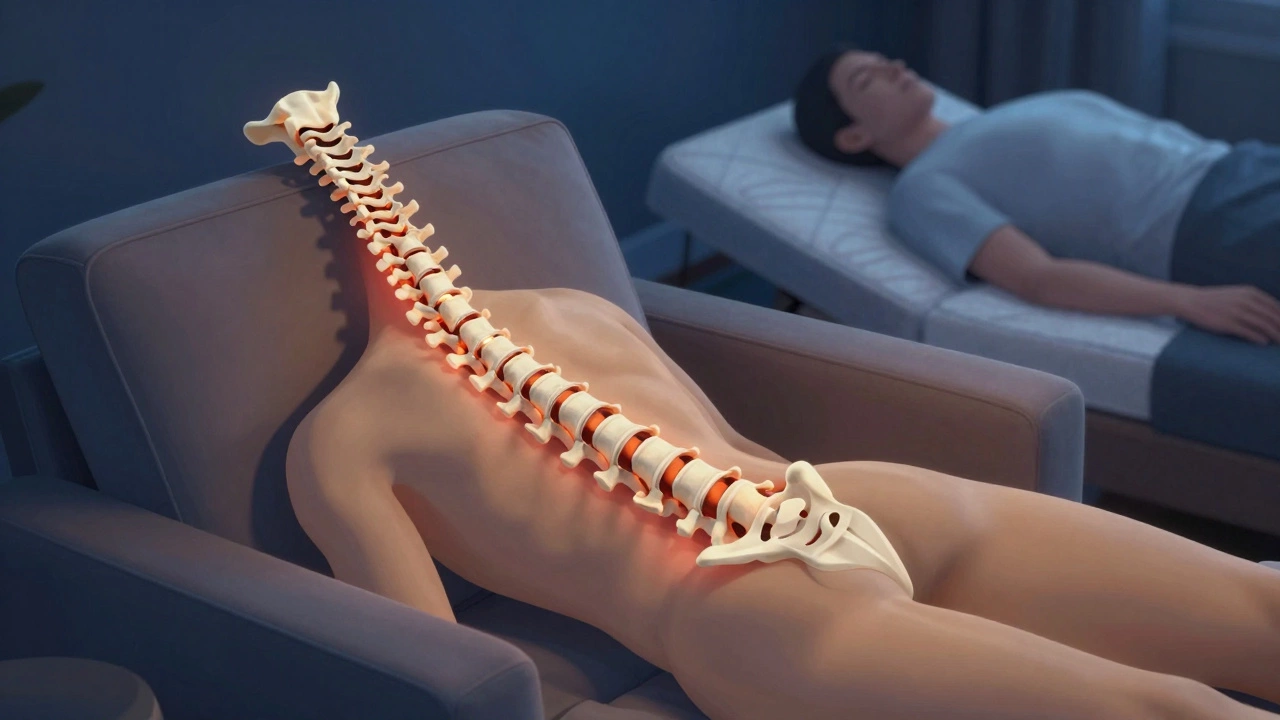
When you sleep on a couch, your spine doesn’t get the support it needs. Most couches are designed for sitting, not sleeping. The cushions sink unevenly, forcing your neck into a twisted angle, your lower back to arch unnaturally, and your legs to dangle or bend at odd joints. This isn’t just uncomfortable-it’s biomechanically wrong. Over time, this misalignment can lead to chronic pain, muscle tension, and even nerve compression.
A 2023 study from the Australian Institute of Sleep Medicine tracked 1,200 adults who regularly napped on sofas. Those who slept on couches more than three times a week reported 47% more instances of morning back pain and 38% more headaches than those who slept in beds. The reason? Poor posture during sleep doesn’t just cause discomfort-it disrupts your body’s natural recovery cycle.
You’re not getting real sleep
Sleep isn’t just about closing your eyes. It’s about cycling through stages: light sleep, deep sleep, and REM. Each stage plays a role in memory, healing, and emotional balance. But when you’re lying on a couch, your body is constantly adjusting. You’re not lying flat. You’re half-sitting. Your muscles are tensing to keep you from sliding off. Your neck is straining. Your hips are twisted.
This constant micro-arousal prevents you from entering deep, restorative sleep. You might think you slept for six hours, but if you were on the couch, your brain never fully settled into the rhythm it needs. You wake up tired-not because you didn’t sleep long enough, but because you didn’t sleep well enough.
People who sleep on couches often report feeling groggy even after long naps. That’s not laziness. That’s sleep fragmentation. Your brain knows something’s off. It stays alert, ready to react to instability-just like it would if you were sleeping on the ground or in a chair.
It messes with your circadian rhythm
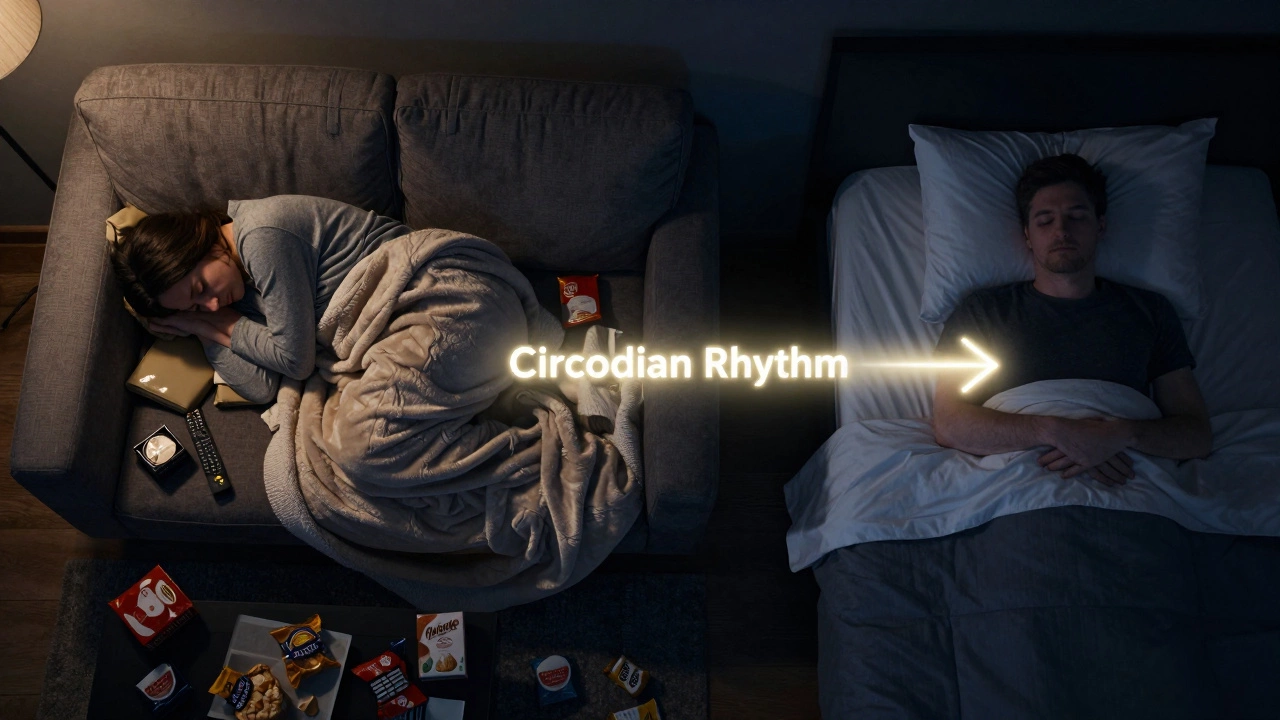
Your body’s internal clock-your circadian rhythm-relies on consistency. When you sleep in the same place, at the same time, under similar conditions, your brain learns: This is sleep time. But if you’re drifting off on the couch after dinner, then moving to the bed later, your brain gets mixed signals.
Think about it: the couch is tied to watching TV, eating snacks, scrolling on your phone. It’s a place of activity, not rest. By training your brain to associate the couch with sleep, you weaken the mental link between your bed and sleep. That makes it harder to fall asleep when you actually want to.
People who use their couch as a regular sleep spot take, on average, 17 minutes longer to fall asleep in bed than those who only sleep in their beds. That’s not just inconvenient-it’s a recipe for insomnia over time.
It’s worse than you think for your breathing
When you sleep on a couch, especially in a slumped or reclined position, your airway can collapse slightly. Your tongue and soft tissues relax and fall back, partially blocking your throat. This isn’t just about snoring-it’s about reduced oxygen flow.
Studies show that sleeping on a couch increases the risk of sleep-disordered breathing by up to 30% compared to sleeping flat on a bed. For people with mild sleep apnea, this can turn a manageable condition into a serious health risk. Even if you don’t have apnea, your body still works harder to breathe, which increases stress hormones like cortisol. That means less recovery, more inflammation, and poorer long-term health.
What about sofa beds? Aren’t they designed for this?
Sofa beds are a compromise. They’re better than a regular couch, but they’re still not a real bed. Most sofa beds have thin, low-density foam mattresses that lose support after just a few months. The frame often creates pressure points along your spine, especially at the hips and shoulders. And let’s not forget the metal mechanisms-those can dig into your back or create uneven surfaces.
A 2025 review by the Australian Sleep Association tested 12 popular sofa bed models. Only two scored above average for spinal support. The rest either sagged too much or were too firm in the wrong places. Even the best sofa beds can’t match the pressure relief of a quality innerspring or memory foam mattress designed for sleeping, not sitting.
If you’re using a sofa bed as your primary sleep surface, you’re not saving space-you’re sacrificing sleep quality. And over months or years, that adds up.
There’s a better way
You don’t need to give up your couch. But you do need to stop using it as a bed. Here’s what works instead:
- If you’re tired after dinner, sit on the couch for 20 minutes, then go to bed. Let your body know the couch is for relaxing, not sleeping.
- Keep a small, supportive pillow on the couch. If you do nod off, prop your neck so it stays aligned with your spine.
- If you’re using a sofa bed because you lack space, consider a fold-out mattress topper. It’s cheaper than a new bed and fits over your sofa for occasional use.
- For guests, invest in a quality air mattress with a built-in pump. It’s easier to store, more comfortable, and won’t damage your sofa bed frame.
Real sleep doesn’t happen on the couch. It happens in a quiet, dark room, on a surface designed to support your body’s natural curves. Your body knows the difference. And if you keep ignoring it, your back, your sleep, and your energy will pay the price.
It’s not about being perfect-it’s about being intentional
You don’t have to be a sleep ninja to fix this. Just make one change: treat your couch like a couch. Use it to unwind. Use it to read. Use it to watch your favorite show. But when it’s time to sleep, move to your bed. Even if it’s just for 30 minutes before you drift off, your body will thank you.
It’s not about discipline. It’s about giving your body what it needs to recover. And your couch? It’s already doing its job-holding your snacks, your blankets, your dog. Let it do that. Let your bed do the rest.
Is it ever okay to sleep on the couch?
Occasionally, yes-if you’re sick, traveling, or in an emergency. But if you’re doing it regularly-more than once or twice a week-it’s a sign your sleep setup needs fixing. Your body needs consistent, supported sleep to recover properly. Couches don’t provide that long-term.
Can a couch cause long-term back pain?
Absolutely. Repeated poor posture during sleep puts constant strain on your spine, muscles, and discs. Over time, this can lead to chronic lower back pain, sciatica, or even herniated discs. People who sleep on couches regularly are twice as likely to seek treatment for back pain than those who sleep in beds.
Why do I feel more tired after napping on the couch?
Because your sleep is fragmented. Your body is fighting to stay balanced on an unstable surface. You never reach deep, restorative sleep stages. That’s why you wake up groggy-even after hours of “sleep.” It’s not rest. It’s survival mode.
Are sofa beds better than regular couches for sleeping?
They’re slightly better, but still not ideal. Most sofa beds have thin, low-quality mattresses that sag quickly and offer poor spinal support. A $200 air mattress with a pump is often more comfortable and supportive than a 10-year-old sofa bed mattress.
How can I stop falling asleep on the couch?
Set a bedtime routine. When you feel sleepy, turn off the TV, dim the lights, and head straight to bed. Keep your bedroom cool, dark, and quiet. If you’re watching TV in bed, use a tablet mount instead of the couch. Train your brain: couch = awake, bed = sleep.